

Introduction
In the demanding world of metal fabrication, even minor inconsistencies can lead to significant production delays, material waste, and eroded profits. For businesses relying on fiber laser cutting technology, the quality of the final product and the efficiency of operations are paramount. Often overlooked, but critically important, are the humble consumables that play a vital role in every cut. Worn-out or sub-standard parts can lead to frustrating downtime and compromised cutting quality. This article delves into how vital fiber laser cutting consumables, particularly nozzles, profoundly influence the precision, speed, and overall performance of your laser cutting machine. Understanding their impact is key to maintaining a competitive edge and ensuring consistent, high-quality output.
Don’t let overlooked components hinder your production. For a detailed guide on essential components, Download Spare Parts Checklist now.
Why Spare Parts & Consumables Matter in Laser Cutting
The operational integrity of a fiber laser cutting machine is a complex interplay of advanced technology and precision-engineered components. Every single part, from the most sophisticated optical lens to the smallest nozzle, contributes to the machine’s overall performance. When these components, especially consumables, are not up to standard or are past their prime, the impact can be detrimental and far-reaching. It’s not just about a single faulty cut; it’s about a cascading effect that can undermine your entire production process.
The immediate impact on performance is often visible in compromised cutting quality. Expect burrs, dross, and inconsistent edge finishes that necessitate costly post-processing. This directly translates into increased labor, slower throughput, and higher operational costs. Moreover, substandard or worn parts force your machine to work harder, leading to premature wear and tear on more expensive components, shortening their lifespan, and incurring significant repair expenses.
The true cost of low-quality parts extends beyond their purchase price. It encompasses the cost of rework, scrapped materials, increased energy consumption due to inefficient cutting, and, most critically, lost production time. Each hour of downtime due to a failed consumable or a poorly performing part represents lost revenue and missed deadlines. Conversely, investing in high-quality, genuine spare parts and consumables ensures your machine operates at peak efficiency, delivering precise cuts consistently, maximizing material utilization, and significantly reducing overall operational expenditure. Machine efficiency is not just about speed; it’s about reliable, consistent output that minimizes waste and maximizes uptime.
Complete Overview of Laser Cutting Machine Spare Parts
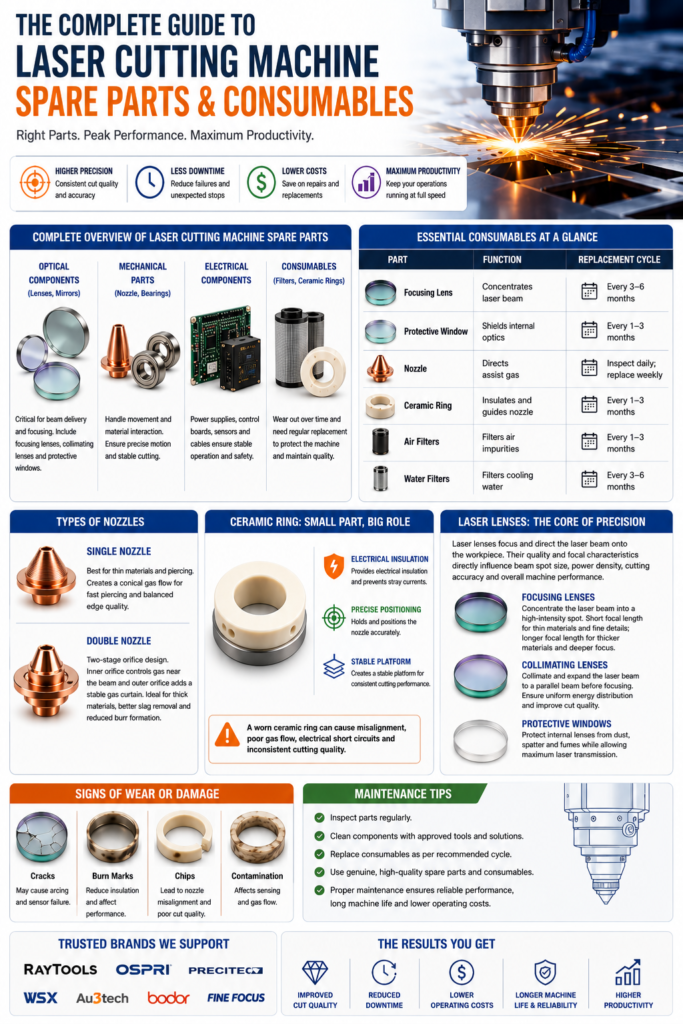
A fiber laser cutting machine is a marvel of engineering, comprising various interconnected systems. Understanding each category of spare parts is crucial for effective maintenance and ensuring continuous, high-quality operation.
Optical Components
These parts are responsible for guiding, focusing, and delivering the laser beam to the workpiece. Their pristine condition is paramount for beam quality and cutting precision.
- Focus Lenses: These lenses concentrate the raw laser beam into a fine, powerful point, crucial for cutting. Scratches, dust, or thermal damage can severely distort the beam, leading to poor cut quality and reduced cutting speed.
- Protective Windows (Cover Slides): Positioned to shield the focus lens from spatter and fumes, these are sacrificial components. A dirty or damaged protective window will absorb laser energy, reduce beam intensity, and cause heating, potentially damaging the focus lens beneath.
- Collimating Lenses: These lenses ensure the laser beam remains parallel as it travels through the optical path, preparing it for precise focusing.
- Mirrors: Found in some older or specialized laser systems, mirrors redirect the laser beam. Contamination or misalignment can cause energy loss and beam distortion.
Mechanical Parts
These components ensure the precise movement and positioning of the laser head and workpiece, facilitating accurate cutting paths.
- Nozzles: Central to the cutting process, nozzles direct the assist gas precisely around the laser beam, clearing molten material and cooling the cutting zone. Their integrity directly impacts cut quality and pierce stability.
- Ceramic Rings (Insulators): These are crucial for the proper functioning of the nozzle assembly, providing electrical insulation and stability. A damaged ceramic ring for laser cutting machine can lead to unstable cutting and poor quality.
- Bearings and Guide Rails: Essential for the smooth and accurate movement of the gantry and laser head, ensuring positional accuracy and cut path integrity. Wear in these components leads to vibration and loss of precision.
- Gear Racks and Pinions: These systems drive the movement along the axes, requiring regular lubrication and inspection for wear to maintain cutting accuracy.
Electrical Components
The electrical system powers and controls every aspect of the machine, from the laser source to the motion controls.
- Sensors: Various sensors monitor machine status, laser head height, gas pressure, and safety parameters. Faulty sensors can lead to operational errors and safety hazards.
- Cables and Connectors: Integral for power delivery and signal transmission, damaged cables can cause intermittent issues or complete system failure.
- Power Supplies: Provide stable power to the laser source, control systems, and other electrical components. Fluctuations or failures can disrupt operation.
Consumables
These are components designed for regular replacement due to wear, contamination, or usage. Their timely replacement is critical for consistent performance.
- Filters: Used in various systems (air, water, gas), filters prevent contamination from affecting sensitive components and maintaining optimal operating conditions. Blocked filters can lead to overheating or poor gas flow.
- fiber laser ceramic rings: As mentioned, these are key consumables, providing electrical insulation and maintaining the stability of the nozzle during cutting.
- Nozzles: Despite being a mechanical part, they are often considered a consumable due to their frequent replacement needs, directly influencing cut quality.
- Protective Windows: These are classic consumables, regularly replaced to protect the more expensive focus lens.
| Part | Function | Replacement Cycle (Typical) |
|---|---|---|
| Nozzle | Directs assist gas, shapes cut | Daily to Weekly, or as needed based on material/quality |
| Protective Window | Shields focus lens from spatter | Daily to Weekly, or as needed based on contamination |
| Focus Lens | Focuses laser beam | Monthly to Quarterly, or as needed if damaged/contaminated |
| Ceramic ring for laser cutting machine | Insulates nozzle, stabilizes arc | Monthly to Quarterly, or as needed if damaged |
| Air/Water Filters | Removes impurities from air/cooling water | Monthly to Quarterly, or as needed based on usage |
| Collimating Lens | Ensures parallel beam path | Annually, or as needed if damaged/contaminated |
Types of Laser Cutting Consumables Explained
Understanding the specific roles and characteristics of key consumables is fundamental to optimizing your laser cutting operations.
Nozzles (Single & Double)
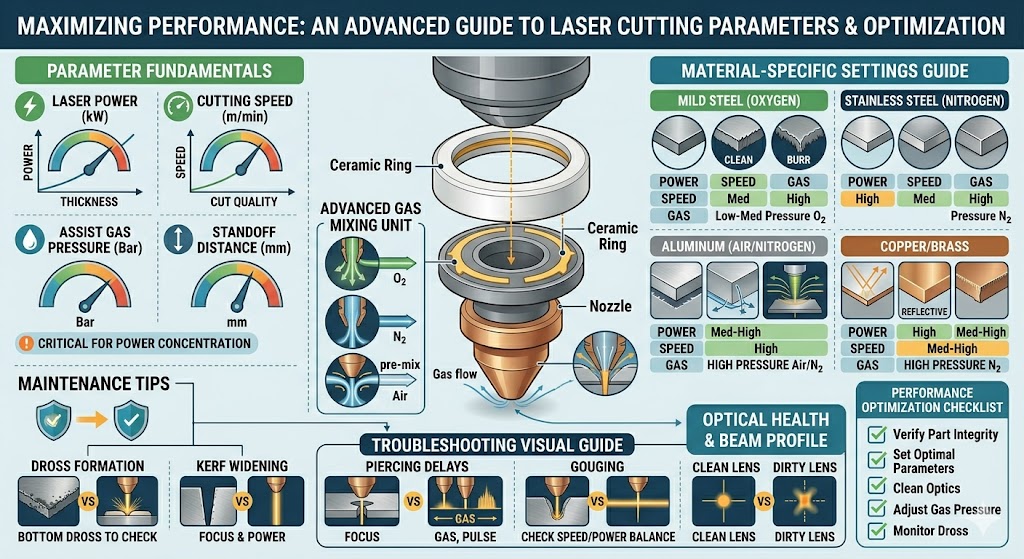
The laser cutting nozzle is a small, yet incredibly powerful component. It sits at the tip of the laser head, precisely controlling the flow of assist gas (oxygen, nitrogen, or air) around the concentrated laser beam. The assist gas plays multiple critical roles: it helps to blow away molten material from the kerf, cools the cutting zone, and in the case of oxygen, supports the exothermic cutting process for mild steel.
The type of nozzle, specifically its design and orifice diameter, significantly impacts the cutting process:
- Single Nozzles: Typically used for oxygen cutting (fusion cutting) of thicker carbon steel. The larger orifice allows for a more robust gas flow to support the exothermic reaction and clear more molten material. Their design focuses on efficient material removal and robust cut initiation.
- Double Nozzles: Primarily used for nitrogen or air cutting (melt and blow cutting) of stainless steel, aluminum, and other non-ferrous metals. The dual concentric orifices create a stronger, more focused gas stream with higher pressure, essential for rapidly expelling molten material and achieving a clean, dross-free edge on these materials. The inner cone provides a focused gas stream, while the outer cone provides a wider, protective gas shroud.
The condition of the nozzle is paramount. Any damage to the orifice, such as burrs, blockages, or an out-of-round shape, will cause the assist gas flow to become turbulent and uneven. This leads to poor cut quality, excessive dross, burrs, and a reduced ability to pierce effectively. Regular inspection and timely replacement of Single & Double Nozzles are non-negotiable for achieving consistent, high-quality results.
Ceramic rings for laser cutting machine
Also known as the laser ceramic ring, this consumable is a small but vital component that fits around the nozzle. Its primary function is to provide electrical insulation and stability for the nozzle during the cutting process. In capacitive height sensing systems, the fiber laser ceramic ring works with the nozzle to maintain a precise and consistent stand-off distance between the laser head and the workpiece. This consistent gap is critical for maintaining focus and ensuring optimal gas flow dynamics.
Damage to the ceramic ring for laser cutting machine, such as cracks, chips, or contamination, can lead to several issues. It can compromise the height sensing function, causing the laser head to crash into the material or cut at an incorrect focal distance. It can also lead to electrical arcing, which damages the nozzle and other parts of the laser head. A well-maintained and genuine ceramic ring for laser cutting machine ensures stable cutting, prolongs the life of the nozzle, and protects the more expensive laser head components.
Lenses (Protective & Focus)
While focus lenses are a more significant investment than simple consumables, protective windows are definitely consumables.
- Protective Windows (Cover Slides): These are expendable optical components positioned directly above the focus lens. Their purpose is to act as a barrier, shielding the expensive focus lens from spatter, fumes, and debris generated during the cutting process. As they accumulate contaminants or become scratched, they start to absorb laser energy, reducing beam power and potentially causing thermal distortion. Regular inspection and replacement are crucial to maintain beam quality and protect the primary focus lens.
- Focus Lenses: These are precision ground optical elements that concentrate the raw laser beam into an extremely small, high-power spot. While not a “consumable” in the daily sense, their lifespan is finite and they require careful handling and cleaning. Any contamination, scratches, or thermal stress on the focus lens directly impairs the beam’s ability to cut efficiently and precisely, leading to poor edge quality, reduced penetration, and slower cutting speeds.
Signs Your Spare Parts Need Replacement
Worn laser cutting parts can significantly affect machine performance, cut quality, and operating costs. Identifying these warning signs early helps prevent costly downtime and repairs.
One of the first indicators is poor cutting quality, including rough edges, excessive dross, or inconsistent kerf width. These issues often result from a worn nozzle or contaminated protective window. Excessive burr formation is another common sign, typically caused by damaged nozzles, dirty optics, or a worn ceramic ring that affects beam alignment and stand-off distance.
Operators should also watch for irregular sparks during cutting. A stable process produces a consistent spark stream, while erratic sparks may indicate nozzle damage, improper gas flow, or focus problems. Similarly, a reduction in cutting speed can occur when protective windows or lenses become dirty and absorb laser energy, reducing cutting efficiency.
Frequent piercing failures, such as difficulty piercing material or uneven pierce holes, often point to worn nozzles or contaminated optical components. More serious warnings include electrical arcing or machine error messages related to height sensing, which may indicate a faulty ceramic ring requiring immediate replacement.
Another overlooked sign is increased assist-gas consumption. A damaged or improperly seated nozzle can disrupt gas flow, causing higher gas usage and unnecessary operating expenses.
Regular inspection of nozzles, protective windows, lenses, and ceramic rings ensures consistent cutting performance, lower maintenance costs, and longer equipment life. Addressing wear before it causes major failures helps maintain productivity and delivers the high-quality results expected from modern laser cutting systems.
OEM vs Aftermarket Spare Parts
When sourcing spare parts and consumables for your fiber laser cutting machine, a critical decision arises: Original Equipment Manufacturer (OEM) parts versus aftermarket alternatives. This choice has significant implications for machine performance, longevity, and your bottom line.
OEM parts are manufactured by or for the original machine builder. They are designed to exact specifications, tested rigorously, and guaranteed to be compatible with your specific machine model. Aftermarket parts, conversely, are produced by third-party manufacturers. While they might be more affordable upfront, their quality, precision, and reliability can vary wildly.
| Feature | OEM Spare Parts | Aftermarket Spare Parts |
|---|---|---|
| Quality & Precision | Highest, guaranteed to spec, rigorous testing | Varies greatly, can be lower quality or imprecise |
| Compatibility | 100% guaranteed fit and function | May require modifications, fit issues possible |
| Performance | Optimal machine performance, maintains warranty | Can degrade performance, may void warranty |
| Lifespan | Designed for maximum durability and service life | Often shorter lifespan, more frequent replacements |
| Technical Support | Full manufacturer support, reliable troubleshooting | Limited or no support from machine manufacturer |
| Cost | Higher initial investment | Lower initial cost, but higher long-term risk |
| Risk | Lowest risk of damage, downtime, or poor quality | Higher risk of machine damage, downtime, inconsistent quality |
While the appeal of lower-priced aftermarket parts is understandable, the potential hidden costs can quickly outweigh any initial savings. Compromised cut quality, increased downtime, accelerated wear on other machine components, and even voiding your machine’s warranty are all risks associated with non-OEM parts. For critical consumables like Single & Double Nozzles, protective windows, and ceramic ring for laser cutting machine, the precision and material integrity offered by OEM or reputable branded alternatives like Raytools, OSPRI, Precitec, and Fine Focus are invaluable.
How to Choose High-Quality Spare Parts Supplier
Selecting the right supplier for fiber laser cutting machine spare parts is essential for maintaining performance, reliability, and productivity. A trusted supplier ensures access to genuine, high-quality components that extend equipment life and reduce downtime.
Start by evaluating quality certifications and manufacturing standards. Suppliers that comply with international standards, such as ISO certifications, typically maintain strict quality control processes and deliver consistent, reliable products.
Industry expertise and brand compatibility are equally important. Choose suppliers with specialized knowledge of laser cutting technology and experience supporting major cutting head brands such as Raytools, OSPRI, Precitec, and Fine Focus. Their expertise can help ensure proper part selection and optimal machine performance.
Reliable technical support and after-sales service are key factors. A dependable supplier should provide prompt assistance with product selection, troubleshooting, installation guidance, warranty claims, and returns when needed.
Since production interruptions can be costly, assess the supplier’s inventory availability and delivery capabilities. Suppliers with a broad stock of commonly used consumables—including single nozzles, double nozzles, protective windows, and ceramic rings—can minimize lead times and keep operations running smoothly.
It is also advisable to review the supplier’s industry reputation. Customer testimonials, online reviews, and recommendations from other laser cutting professionals can provide valuable insights into product quality, service reliability, and overall customer satisfaction.
Finally, consider overall value rather than price alone. While competitive pricing is important, investing in high-quality parts from a reputable supplier often results in lower long-term costs through improved durability, better cutting performance, and reduced maintenance requirements.
By prioritizing quality, expertise, support, availability, and reputation, businesses can establish a reliable supply chain and maximize the efficiency of their fiber laser cutting operations.
Maintenance Tips to Increase Machine Life
Regular maintenance is essential for maximizing the lifespan, efficiency, and cutting performance of a fiber laser cutting machine. A proactive maintenance routine helps prevent costly breakdowns, reduces downtime, and ensures consistent production quality.
One of the most important practices is the regular cleaning of optical components. Focus lenses and protective windows should be cleaned with approved optical solutions and lint-free materials to prevent dust, residue, and smudges from reducing laser power or causing overheating.
Operators should also inspect nozzles daily. Single and double nozzles must remain clean, free of spatter, and properly aligned with the laser beam. Damaged or misaligned nozzles can disrupt assist-gas flow, leading to poor cut quality and reduced efficiency. Worn nozzles should be replaced immediately.
Another key practice is the timely replacement of consumables, including protective windows, ceramic rings, and filters. Replacing these components according to recommended service intervals helps maintain stable machine performance and protects more expensive parts from damage.
Regular lubrication of guide rails, bearings, and gear racks ensures smooth movement of the laser head and gantry, minimizing mechanical wear and preserving cutting accuracy. In addition, periodic calibration checks of optical alignment and height sensing systems help maintain precision and consistent results.
The cooling system should also be monitored closely. Clean cooling water, proper temperature control, and a well-maintained chiller are critical for preventing overheating and protecting the laser source.
Finally, maintaining a clean working environment reduces dust accumulation on optical and mechanical components, improving reliability and extending equipment life.
By following these maintenance practices, manufacturers can enhance productivity, improve cut quality, reduce repair costs, and maximize the return on their fiber laser cutting machine investment.
Cost Optimization Strategy
Effective cost optimization in fiber laser cutting isn’t about cutting corners; it’s about smart investments and proactive management that minimize waste and maximize returns.
- Strategic Bulk Buying of Consumables: For high-usage consumables like nozzles, protective windows, and fiber laser ceramic rings, purchasing in bulk from trusted suppliers can secure significant per-unit discounts. This reduces the cost of essential parts and ensures you always have stock on hand, preventing production halts.
- Implementing a Robust Preventive Maintenance Schedule: As discussed, preventive maintenance is crucial. By regularly inspecting and replacing worn parts before they fail, you avoid costly emergency repairs, extensive downtime, and damage to more expensive components. This foresight directly translates into lower overall operating costs and increased machine uptime.
- Exclusively Using Genuine and High-Quality Consumables: While aftermarket parts may offer a lower initial price, genuine or branded consumables from reputable manufacturers like Raytools, Precitec, OSPRI, and Fine Focus deliver superior performance, longer lifespans, and consistent quality. This reduces the frequency of replacements, minimizes material waste due to poor cuts, and protects your valuable machine, leading to lower total cost of ownership.
- Optimizing Assist Gas Usage: Fine-tune your assist gas parameters (pressure, flow rate) for different materials and thicknesses. An efficient Single Nozzle or Double Nozzle combined with optimized gas settings can significantly reduce gas consumption, a major operational cost.
- Operator Training and Skill Development: Well-trained operators can identify issues earlier, perform routine maintenance correctly, and optimize cutting parameters, all of which contribute to reduced waste, increased efficiency, and longer part life.
Applications & Industry Use Cases
Fiber laser cutting machines, supported by high-quality consumables, are indispensable across a wide spectrum of industries due to their precision, speed, and versatility.
- Automotive Industry: From cutting lightweight chassis components to intricate interior parts and specialized prototypes, fiber lasers provide the accuracy and speed required for mass production and custom vehicle fabrication. Precision cuts for gears, brackets, and panels are routine.
- Sheet Metal Fabrication: This is perhaps the largest application area. Manufacturers creating everything from architectural facades and HVAC ducting to custom enclosures and industrial machinery rely on fiber lasers for rapid, precise, and clean cuts on various metals, including stainless steel, mild steel, and aluminum. The reliability of Single Nozzles and Double Nozzles ensures consistent quality across large batches.
- General Fabrication and Job Shops: Small to large job shops leverage fiber lasers for their flexibility in handling diverse projects, from custom metal signs and furniture components to parts for agricultural machinery and construction equipment. The ability to switch between materials and designs with minimal setup time is a huge advantage.
- Aerospace Industry: The demand for lightweight, high-strength materials like titanium and advanced alloys requires cutting technology that offers extreme precision and minimal material distortion. Fiber lasers, when fitted with optimal consumables, meet these stringent requirements for aircraft components and structural elements.
- Medical Device Manufacturing: For precision components in medical instruments and implants, fiber lasers provide incredibly fine cuts with minimal heat-affected zones, crucial for biocompatibility and functional integrity.
- Electronics Industry: Cutting thin metals for enclosures, connectors, and heat sinks requires very high precision and minimal thermal impact, making fiber lasers an ideal choice.
Conclusion
The performance of your fiber laser cutting machine is profoundly influenced by the quality and maintenance of its consumables, with nozzles playing a particularly critical role. From ensuring precise gas flow for clean cuts to maintaining optimal machine efficiency, genuine and well-maintained components are the silent workhorses behind every successful fabrication project. Investing in high-quality spare parts, such as those from reputable brands like Raytools, OSPRI, Precitec, and Fine Focus, coupled with a proactive maintenance strategy, is not merely an expense but a strategic decision that drives performance improvement, cost optimization, and significantly extends the lifespan of your valuable machinery. Don’t compromise on quality when it comes to the intricate heart of your cutting operations.
Ready to enhance your laser cutting operations?
Request a Quote for genuine laser cutting spare parts and consumables today.
Talk to an Expert to discuss your specific machine needs and optimization strategies.
Download our Catalog for a comprehensive overview of our high-quality product range.
FAQs
- Q1: How often should laser cutting nozzles be replaced?
- The replacement interval for single and double nozzles depends on factors such as material type, thickness, assist gas quality, and machine usage. Daily inspections are recommended. Replace nozzles immediately if they show signs of wear, damage, deformation, or if cutting quality begins to decline.
- Q2: What is the purpose of a ceramic ring in a laser cutting machine?
- A ceramic ring provides electrical insulation between the nozzle and cutting head while supporting the machine’s capacitive height-sensing system. It helps maintain a precise stand-off distance between the laser head and workpiece, ensuring accurate focus and stable cutting performance.
- Q3: Can aftermarket spare parts affect my machine warranty?
- Yes. Using non-OEM or unauthorized replacement parts may void your machine’s warranty, depending on the manufacturer’s policies. Always review warranty terms and verify component compatibility before installing aftermarket parts.
- Q4: How can I tell when a protective window needs replacement?
- A protective window should be replaced if it appears cloudy, scratched, cracked, or has permanent spatter buildup. Reduced cutting performance, lower laser power efficiency, and inconsistent cut quality are also common signs that replacement is necessary.
- Q5: Why is assist gas purity important in laser cutting?
- High-purity assist gas is essential for achieving clean, precise cuts. Contaminants such as moisture, oil, or particles can reduce cutting efficiency, increase dross formation, compromise edge quality, and accelerate contamination of optical components and nozzles.
- Q6: Which brands are known for quality laser cutting consumables?
- Several manufacturers are widely recognized for producing reliable laser cutting consumables, including Raytools, OSPRI, Precitec, and Fine Focus. Their products are designed to meet strict quality standards and provide consistent performance across a wide range of laser cutting applications.

Write a comment
Your email address will not be published. All fields are required