

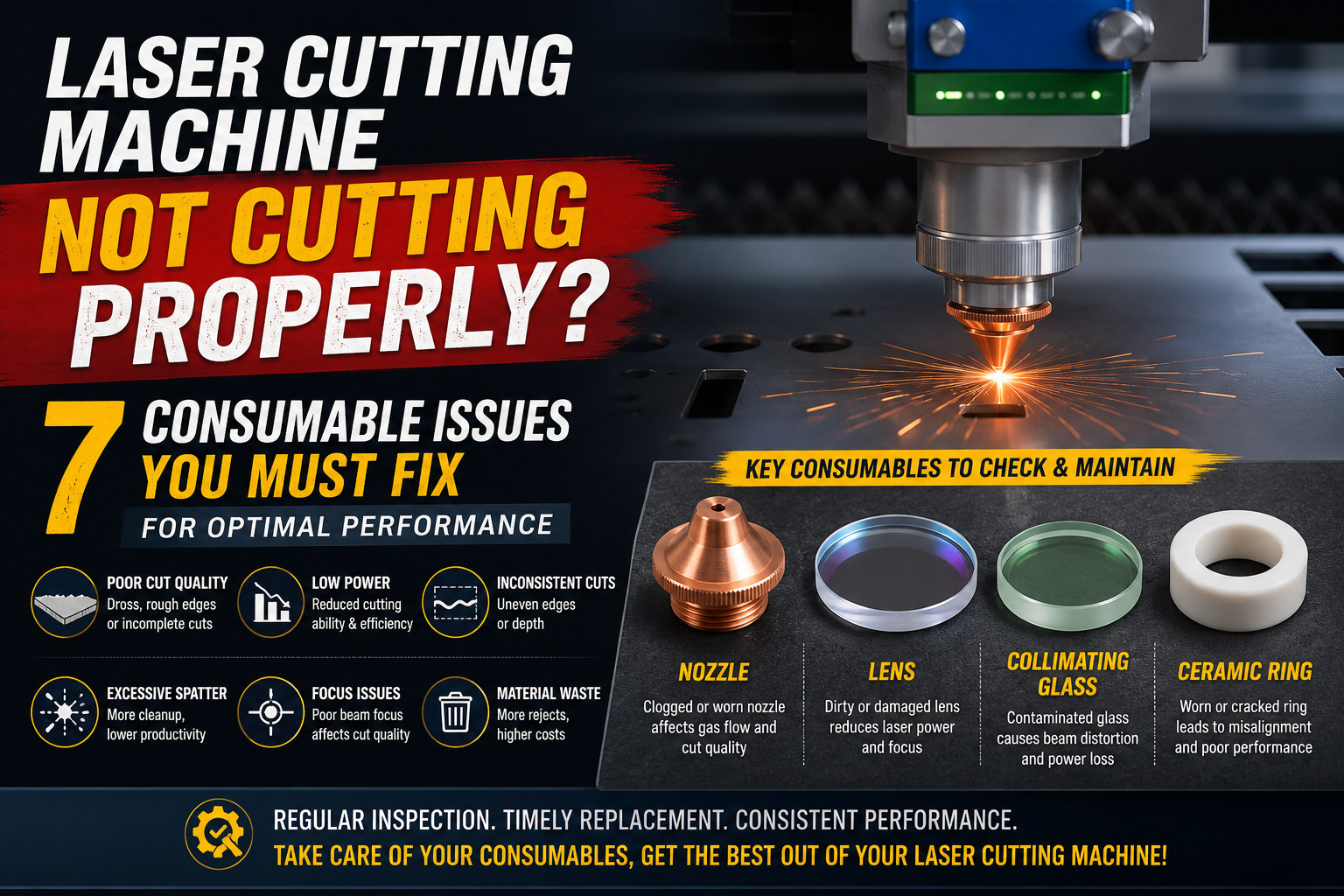
Why Your Fiber Laser Cutting Machine Cuts Poorly: 7 Consumable Fixes
A fiber laser cutting machine is the backbone of modern metal fabrication, delivering the precision and speed needed for high-quality production. When cut quality declines or performance becomes inconsistent, the cause is often not a major machine failure but worn or neglected consumables. Identifying these issues early can help reduce downtime, improve efficiency, and avoid costly repairs.
Understanding common consumable-related problems allows operators and fabricators to maintain optimal cutting performance. From nozzles and lenses to ceramic rings and protective windows, each component plays a critical role in beam delivery, gas flow, and cutting accuracy. Regular inspection and timely replacement are essential for consistent results.
Why Spare Parts and Consumables Matter
The performance and reliability of a fiber laser cutting machine depend heavily on the quality and condition of its spare parts and consumables. Components such as nozzles, lenses, ceramic rings, and protective windows play a critical role in beam delivery, gas flow, cutting accuracy, and overall machine efficiency.
Worn or damaged consumables can lead to poor cut quality, excessive burrs, dross formation, unstable gas flow, slower cutting speeds, and increased material waste. Over time, these issues can also place additional stress on expensive machine components, resulting in higher maintenance costs and unplanned downtime. Using high-quality spare parts and replacing consumables on schedule helps maintain consistent performance, improve productivity, and extend machine life.
A Complete Overview of Laser Cutting Machine Spare Parts
Understanding the main categories of laser cutting machine spare parts is essential for effective maintenance and long-term reliability.
Optical Components
This category includes lenses, mirrors, and protective windows that guide and focus the laser beam. Clean, undamaged optics are essential for maintaining beam quality and cutting precision.
Mechanical Parts
Nozzles, bearings, and guide rails support the movement and positioning of the cutting head. Wear in these components can cause misalignment, vibration, and reduced cutting accuracy.
Electrical Components
Sensors, cables, and drivers control machine operation and power delivery. Faulty electrical components can lead to inconsistent performance, system errors, or machine shutdowns.
Consumables
Consumables such as nozzles, ceramic rings, lenses, and filters naturally wear during operation and require periodic replacement. Regular inspection and timely replacement help maintain optimal cutting performance and prevent costly failures.
By investing in quality spare parts and following a proactive maintenance schedule, manufacturers can improve efficiency, reduce downtime, and ensure consistent cutting results.
Quick Reference: Key Parts and Replacement Cycles
| Part | Function | Replacement Cycle |
| Nozzle | Directs assist gas, shapes beam exit | Daily inspection; replace weekly/monthly |
| Ceramic Ring | Insulates and positions the nozzle | Monthly to Quarterly, or upon damage |
| Protective Lens | Shields internal optics from spatter | Weekly to Monthly, or upon contamination |
| Focusing Lens | Concentrates laser beam | Quarterly to Annually, or upon degradation |
| Air/Gas Filter | Removes impurities from assist gas | Monthly to Quarterly, based on usage |
| Water Filter | Maintains coolant purity | Quarterly to Annually |
Types of Laser Cutting Consumables Explained
Understanding specific consumable types helps you recognize common issues early and take preventative action before they affect production.
Nozzles (Single and Double)
The nozzle directs assist gas precisely onto the cutting zone while also shaping the laser beam’s exit point. Single nozzles work best for oxygen cutting, while double nozzles suit nitrogen cutting because they offer better gas flow characteristics. When a nozzle wears out or falls out of alignment, it causes inconsistent gas flow, beam misalignment, excessive dross, and even blow-outs. Therefore, operators should inspect and replace nozzles regularly.
Ceramic Rings
The ceramic ring for laser cutting machines holds the nozzle in place and provides electrical insulation for the cutting head. It also senses the distance to the material via capacitance, which is crucial for maintaining optimal focus. When the ceramic ring sustains damage or contamination, the laser head cuts at the wrong focal height. As a result, cut quality suffers, burring increases, and cutting speed drops. Always choose genuine ceramic rings from quality brands like Raytools, OSPRI, or Precitec.
Lenses (Focusing Lens and Protective Window)
The focusing lens concentrates the laser beam to a tiny spot on the material, which determines cut width and quality. Meanwhile, the protective window shields the focusing lens from spatter and fumes. When either lens accumulates contamination from dust, oil, or smoke, it scatters and absorbs laser energy. This reduces beam power, increases heat, and ultimately causes poor cuts and thermal damage. Consequently, clean your lenses daily with approved optical wipes and replace them on schedule.
Signs Your Spare Parts Need Replacement
Recognizing early warning signs of worn or faulty spare parts is key to preventing major breakdowns. Moreover, early action keeps your cutting quality consistent and your production schedule on track.
Poor cutting quality is often the most obvious sign. Excessive dross, uneven cut edges, or incomplete cuts typically point to problems with the nozzle, ceramic ring, or lenses. Additionally, burr formation along the cut edge indicates insufficient power density or improper assist gas flow, which a worn nozzle or contaminated protective lens usually causes.
Irregular sparks or an unstable flame during cutting also signal trouble. Specifically, this suggests a problem with the nozzle’s integrity, its alignment, or the assist gas delivery system. Similarly, a noticeable reduction in cutting speed for a given material and power setting often means the focusing lens is degraded or the ceramic ring is affecting focal height.
Machine alarms and error codes are another clear indicator. Modern machines throw alerts related to gas pressure, head collision, or power issues. These often trace back to failing sensors in the ceramic ring or other electrical components. Furthermore, material discoloration or excessive heat-affected zones point to poor gas shielding, which a worn nozzle typically causes.
OEM vs Aftermarket Spare Parts
When replacing spare parts, operators face a key decision between Original Equipment Manufacturer parts and aftermarket alternatives. Both options offer distinct advantages, so understanding the difference helps you make a smarter choice.
OEM parts come from the original machine manufacturer. Because engineers design them to exact specifications, they guarantee perfect fit, form, and function. As a result, OEM parts deliver optimal performance, reliability, and often include manufacturer warranties. However, they typically cost more upfront.
Aftermarket parts come from third-party manufacturers. They are generally more affordable, which makes them an attractive alternative. While many reputable aftermarket suppliers provide high-quality components compatible with Raytools, OSPRI, Precitec, or Fine Focus systems, quality varies significantly between suppliers. Some aftermarket parts fail to meet OEM specifications, which leads to reduced performance, shorter lifespan, and potential compatibility issues. Therefore, always vet your aftermarket supplier carefully before purchasing.
OEM vs Aftermarket: Key Comparison
| Feature | OEM Spare Parts | Aftermarket Spare Parts |
| Quality | Guaranteed highest quality and compatibility | Varies significantly; can be high or low quality |
| Cost | Higher initial cost | Lower initial cost; potential for higher long-term costs |
| Performance | Optimal and consistent | May lead to varied or sub-optimal performance |
| Warranty | Often includes manufacturer warranty | Typically no machine warranty |
| Risk | Minimal incompatibility risk | Higher risk of compatibility issues and downtime |
How to Choose a High-Quality Spare Parts Supplier
Selecting the right supplier for your fiber laser cutting consumables is just as important as choosing the right parts. A reliable supplier ensures you receive genuine, high-performance components that extend machine life and optimize output.
First, look for certifications and quality standards. A reputable supplier follows international quality standards such as ISO certifications and provides parts that meet or exceed OEM specifications. Second, confirm brand compatibility and authenticity. Ensure the supplier offers genuine or officially compatible parts for brands like Raytools, OSPRI, Precitec, and Fine Focus. Be cautious of unbranded parts with unrealistically low prices.
Third, evaluate the supplier’s technical support and expertise. A good supplier employs knowledgeable staff who can assist with part selection, installation guidance, and troubleshooting. Fourth, consider inventory and logistics. Because timely delivery is critical to minimizing downtime, choose a supplier with strong inventory and reliable shipping. Finally, check customer reviews and references from other metal fabricators to confirm the supplier’s reliability and product quality.
Maintenance Tips to Increase Machine Life
Proactive maintenance is the foundation of maximizing your laser cutting machine’s lifespan and efficiency. By following a consistent maintenance schedule, you can prevent most common consumable-related issues before they escalate.
Clean your optical components every day. Use only approved optical cleaning solutions and lint-free wipes to remove dust, oil, and spatter from the focusing lens and protective window. Even a tiny speck of contamination absorbs laser energy and causes thermal damage, so do not skip this step.
Inspect your nozzle daily for wear, damage, or contamination. Ensure it is perfectly centered with the laser beam, because misalignment drastically affects cut quality and gas flow. Replace worn nozzles immediately rather than waiting for visible failure.
Replace all consumables on schedule. Follow the manufacturer’s recommended replacement intervals for ceramic rings, nozzles, and filters. Even when a part appears functional, its performance degrades over time. Therefore, preventive replacement is always cheaper than an emergency breakdown.
Maintain assist gas purity by checking and replacing gas filters regularly. Impurities contaminate optics and compromise cut quality. Also, monitor your water chiller system by checking coolant levels, water quality, and filter condition consistently, because contaminated coolant severely impacts laser performance. Finally, lubricate guide rails, bearings, and other moving parts to ensure smooth, accurate motion and prevent premature wear.
Cost Optimization Strategy
Balancing high-performance output with cost-effectiveness is an ongoing challenge for metal fabricators. However, a smart cost optimization strategy for consumables delivers significant savings without sacrificing quality.
Buying genuine consumables in bulk often reduces unit costs. Establishing long-term relationships with trusted suppliers helps you negotiate better pricing and maintain a steady supply of quality components. Furthermore, implementing predictive and preventive maintenance saves money by preventing catastrophic failures that are far more expensive to repair. Instead of waiting for parts to fail, schedule replacements during planned downtime based on manufacturer guidance and machine diagnostics.
Although aftermarket parts may seem cheaper upfront, genuine consumables offer superior performance, longer lifespan, and fewer issues. As a result, you reduce overall operational costs over time. Additionally, well-trained operators reduce material waste and consumable wear through correct parameter settings and daily cleaning routines. Finally, optimize your inventory so you maintain critical items without overstocking and tying up unnecessary capital.
Applications and Industry Use Cases
Fiber laser cutting technology plays a pivotal role across numerous industrial sectors. Understanding these applications highlights why maintaining optimal machine performance matters so much.
Automotive Industry
In the automotive industry, laser cutting produces precision components, prototypes, and lightweight structures. Because the demand for clean and accurate cuts is extremely high, machine performance is non-negotiable.
Sheet Metal Fabrication
In sheet metal fabrication, laser cutting covers everything from architectural panels and HVAC ductwork to industrial enclosures and custom metal artwork. Its ability to cut diverse metals with high precision makes it the preferred method across the industry.
General Manufacturing
In general manufacturing, laser cutting produces parts for agricultural machinery, construction equipment, electronics housings, signage, and much more.
Aerospace Industry
In the aerospace sector, engineers rely on laser cutting for critical components made from specialized alloys because tight tolerances and minimal material deformation are essential.
Medical Device Manufacturing
In medical device manufacturing, laser cutting produces small, intricate, and highly precise components for instruments and implants where accuracy is critical.
Frequently Asked Questions
How often should I replace my laser cutting machine nozzle?
The replacement frequency depends on material type, gas type, and power level. Generally, inspect the nozzle daily. Replace it weekly or monthly for optimal performance, and replace it immediately if you observe any damage or significant wear.
What causes a laser cutter to not cut all the way through?
Insufficient laser power is one cause. Additionally, incorrect focus height from a faulty ceramic ring, contaminated or degraded lenses, improper assist gas pressure, or a worn and misaligned nozzle all contribute to incomplete cuts.
Are branded consumables worth the extra cost?
Yes, branded consumables from manufacturers like Raytools, OSPRI, Precitec, and Fine Focus are worth the investment. They deliver guaranteed quality, optimal performance, and a longer lifespan. Consequently, they reduce the risk of downtime and costly machine damage, which leads to better overall cost optimization.
How does a damaged ceramic ring affect cutting quality?
A damaged ceramic ring causes inaccurate distance sensing, which makes the laser head cut at an incorrect focal height. As a result, cut quality deteriorates with excessive dross, burrs, and inconsistent cutting because the laser beam no longer focuses optimally on the material surface.
What is the difference between a single nozzle and a double nozzle?
A single nozzle has one orifice for assist gas and works best with oxygen for mild steel cutting. A double nozzle features two orifices, which allows for better gas flow and shielding. Therefore, it is ideal for high-pressure nitrogen cutting of stainless steel and aluminum to achieve dross-free cuts.
How can I identify a genuine Raytools lens?
Genuine Raytools lenses carry specific engravings, serial numbers, and come in branded packaging with verification codes. To avoid counterfeit products that can damage your machine, purchase only from authorized distributors.
Conclusion
Keeping your fiber laser cutting machine at peak performance depends significantly on how well you manage its consumables and spare parts. When your machine stops cutting properly, the solution usually involves addressing these frequently overlooked components. From the precision of the nozzle to the insulating function of the ceramic ring and the clarity of your lenses, each part contributes directly to cut quality and machine efficiency.
Investing in genuine parts from trusted brands like Raytools, OSPRI, Precitec, and Fine Focus is therefore a strategic business decision. By learning to recognize signs of wear, choosing reputable suppliers, and committing to a rigorous preventive maintenance schedule, you minimize downtime, reduce material waste, and extend the lifespan of your equipment. As a result, your fiber laser cutting machine runs smoothly, profitably, and consistently for years to come.


Write a comment
Your email address will not be published. All fields are required