

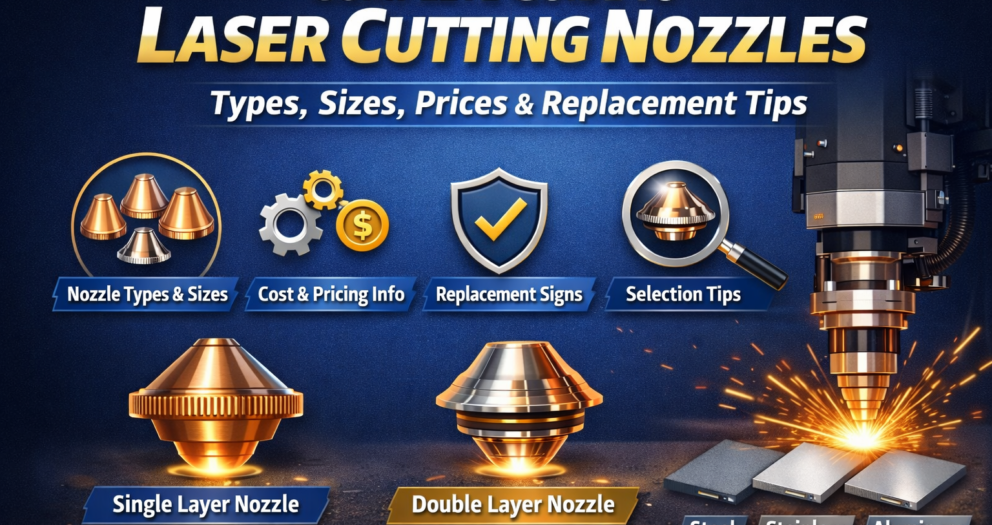
Laser cutting nozzles are small components with a massive impact on cut quality, gas flow, and production cost. Choosing the right nozzle directly affects laser cutting burr, edge finish, and nozzle lifespan.
In this complete pillar guide, you’ll learn everything about single vs double layer nozzle, laser nozzle sizes, nozzle for MS SS aluminum, laser nozzle price, nozzle alignment, nozzle height, nozzle gas usage, and how to replace laser nozzle correctly.
What is a Laser Cutting Nozzle and Why It Matters?
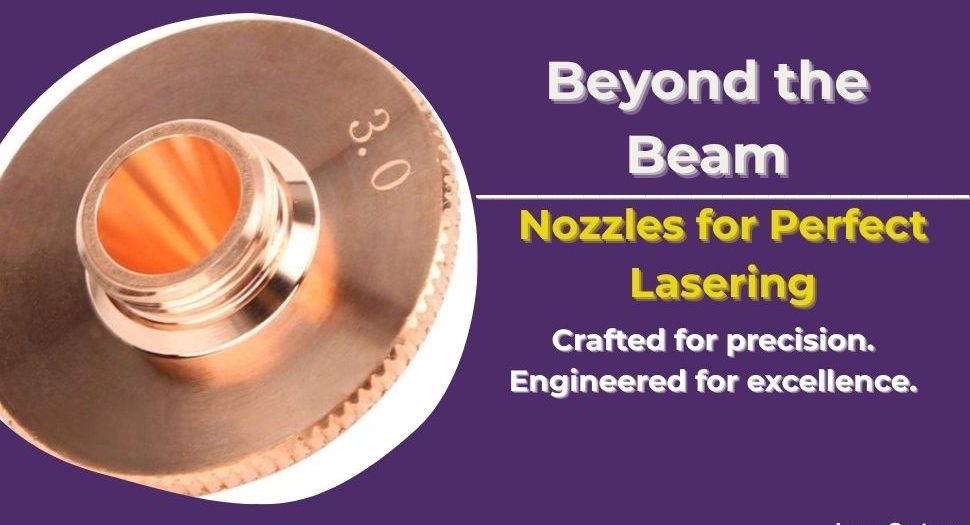
A laser cutting nozzle is the metal tip mounted at the bottom of the laser head that directs assist gas to the cutting zone. It controls gas flow, protects the focusing lens, and stabilizes the laser beam during cutting.
Without the correct nozzle, even a high-end fiber laser machine will produce poor edge quality, excessive burr, and unstable cuts.
Why Laser Nozzles Are Critical:
- Direct assist gas (O₂, N₂, air) precisely to the cut area
- Protect internal optics from molten splash
- Control gas pressure distribution
- Improve cut edge smoothness
- Reduce laser cutting burr
- Influence nozzle gas usage efficiency
- Affect nozzle lifespan and maintenance frequency
Single vs Double Layer Nozzle: Which One Should You Use?
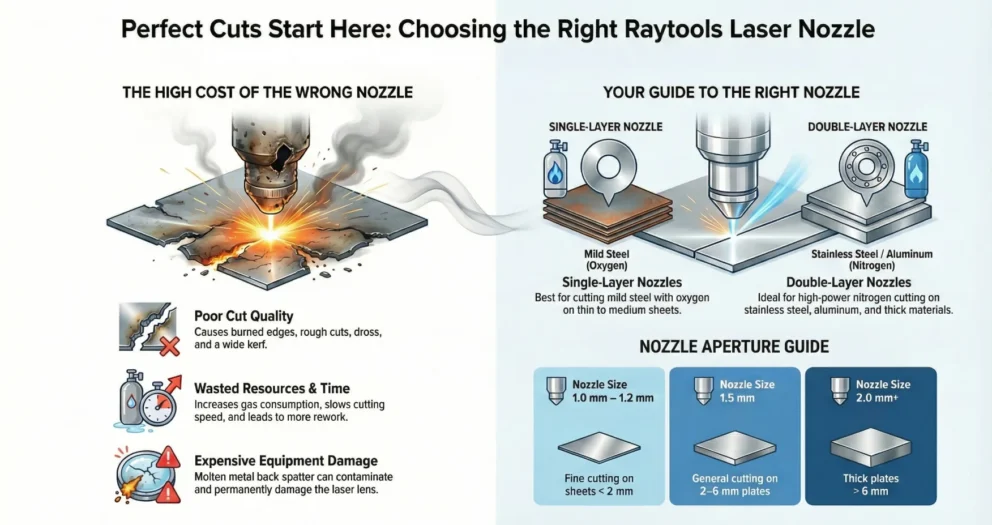
Single vs double layer nozzle selection depends mainly on material type, thickness, and gas used. Single layer nozzles are ideal for nitrogen cutting, while double layer nozzles are preferred for oxygen cutting of mild steel.
Understanding the difference is crucial for quality and cost control.
Single Layer Nozzle
Single layer nozzles have one gas channel and are commonly used for nitrogen cutting. They provide stable high-pressure gas flow for stainless steel and aluminum cutting.
These nozzles are widely used in fiber laser cutting applications.
Best Use Cases:
- Nozzle for SS cutting
- Nozzle for aluminum cutting
- Nitrogen high-pressure cutting
- Nozzle for thin sheet (0.5mm – 6mm typical range)
Benefits:
- Lower laser cutting burr
- Better edge finish on SS and aluminum
- Simple structure
- Affordable laser nozzle price
- Easier to clean laser nozzle
Double Layer Nozzle
Double layer nozzles have two gas channels and are mainly used with oxygen for mild steel cutting. They improve gas stability and enhance combustion efficiency.
These are commonly used as nozzle for MS cutting.
Best Use Cases:
- Nozzle for MS (mild steel)
- Nozzle for thick plate
- Oxygen cutting applications
- 6mm to 25mm thick MS
Benefits:
- Stable oxygen flow
- Reduced nozzle damage during thick plate cutting
- Better piercing performance
- Improved cutting speed on MS
Quick Comparison: Single vs Double Layer Nozzle
| Feature | Single Layer | Double Layer |
|---|---|---|
| Gas Type | Nitrogen | Oxygen |
| Material | SS, Aluminum | Mild Steel |
| Pressure | High | Low to Medium |
| Burr Control | Excellent | Good |
| Cost | Lower | Slightly Higher |
Laser Nozzle Sizes: How to Choose Correct Diameter?
Laser nozzle sizes determine gas pressure concentration and cut precision. Smaller diameters focus gas tightly, while larger diameters allow broader gas coverage.
Choosing the correct size reduces burr and improves efficiency.
Common Laser Nozzle Sizes
Typical inner diameters:
- 0.8 mm
- 1.0 mm
- 1.2 mm
- 1.5 mm
- 2.0 mm
- 2.5 mm
- 3.0 mm
How to Select Laser Nozzle Sizes
Laser nozzle sizes should match material thickness and gas type. Thin sheets need smaller diameters, while thick plates require larger diameters for better gas evacuation.
For Thin Sheets (Nozzle for Thin Sheet):
- 0.8mm – 1.2mm
- High-pressure nitrogen
- SS & aluminum
For Thick Plates (Nozzle for Thick Plate):
- 1.5mm – 3.0mm
- Oxygen or nitrogen
- MS thick cutting
Selection Checklist:
- Material type (MS, SS, aluminum)
- Thickness
- Gas type
- Machine power
- Desired edge finish
Nozzle for MS, SS, Aluminum: Material-Based Selection Guide
Different metals require different nozzle configurations for optimal cutting. Gas type, thickness, and surface quality requirements determine the best nozzle choice.
Nozzle for MS (Mild Steel)
Mild steel cutting typically uses oxygen and double layer nozzles. These enhance combustion and improve cutting speed.
Recommended Setup:
- Double layer nozzle
- Diameter: 1.2mm – 2.5mm
- Oxygen gas
Nozzle for SS (Stainless Steel)
Stainless steel cutting requires nitrogen and single layer nozzles for oxidation-free edges.
Recommended Setup:
- Single layer nozzle
- 1.0mm – 2.0mm
- High-pressure nitrogen
Nozzle for Aluminum
Aluminum cutting needs stable high-pressure nitrogen and precision nozzle alignment.
Recommended Setup:
- Single layer nozzle
- 1.0mm – 1.5mm
- Proper nozzle height control
Nozzle Height & Nozzle Alignment: Precision Matters
Nozzle height and nozzle alignment directly affect cut quality and burr formation. Incorrect setup causes uneven gas flow and nozzle crash risks.
What is Ideal Nozzle Height?
Nozzle height refers to the distance between nozzle tip and material surface. Ideal height typically ranges between 0.6mm to 1.2mm depending on material.
Effects of Wrong Nozzle Height:
- Excessive laser cutting burr
- Poor edge finish
- Increased nozzle damage
- Gas wastage
Nozzle Alignment Explained
Nozzle alignment ensures the laser beam is centered inside the nozzle. Misalignment causes uneven cutting and nozzle damage.
Signs of Poor Alignment:
- Sparks hitting nozzle edge
- Irregular kerf width
- Frequent nozzle crash
- Reduced nozzle lifespan
Laser Cutting Burr: How Nozzle Affects It
Laser cutting burr is often caused by incorrect nozzle size, height, or gas pressure. Choosing the right nozzle minimizes secondary finishing work.
Burr Causes Related to Nozzle:
- Incorrect laser nozzle sizes
- Worn-out nozzle
- Improper nozzle gas usage
- Dirty tip (need to clean laser nozzle)
How to Reduce Burr:
- Adjust nozzle height
- Check nozzle alignment
- Replace laser nozzle if damaged
- Optimize gas pressure
Nozzle Gas Usage & Efficiency
Nozzle gas usage directly impacts operating cost. Correct nozzle diameter reduces unnecessary gas consumption.
How to Optimize Gas Usage:
- Use correct nozzle size
- Maintain proper nozzle height
- Avoid oversized diameter
- Inspect nozzle for damage
Nozzle Lifespan: How Long Does It Last?
Nozzle lifespan depends on material type, crash frequency, and maintenance habits. On average, nozzles last from 1 week to 3 months in production environments.
Factors Affecting Nozzle Lifespan:
- Nozzle crash incidents
- Thick plate cutting
- Improper storage
- Lack of cleaning
Nozzle Damage & Nozzle Crash: Causes and Prevention
Nozzle damage is often caused by collision with material, improper alignment, or heat exposure. A nozzle crash can immediately affect cut quality.
Common Nozzle Damage Types:
- Bent tip
- Burn marks
- Blocked gas hole
- Thread damage
Prevention Tips:
- Use nozzle sensor systems
- Check nozzle alignment daily
- Maintain correct nozzle height
- Store properly
Nozzle Sensor: Smart Protection System
A nozzle sensor detects contact between nozzle and material to prevent crashes. It improves safety and increases nozzle lifespan.
Benefits:
- Reduces downtime
- Prevents expensive head damage
- Protects lens and nozzle
How to Clean Laser Nozzle Properly
To clean laser nozzle, remove debris and oxidation regularly to maintain smooth gas flow.
Cleaning Steps:
- Remove nozzle
- Use soft brush
- Use alcohol wipe
- Check hole roundness
- Reinstall with alignment check
How to Replace Laser Nozzle Correctly
To replace laser nozzle, turn off machine, remove old nozzle, clean threads, and install new one with proper alignment.
Replacement Checklist:
- Inspect for nozzle damage
- Check nozzle alignment
- Adjust nozzle height
- Test cut sample
OEM vs Compatible Nozzle: Which is Better?
OEM vs compatible nozzle comparison depends on budget and quality standards. OEM nozzles guarantee precision, while compatible options offer cost savings.
OEM Nozzle:
- Higher laser nozzle price
- Guaranteed fit
- Longer lifespan
Compatible Nozzle:
- Lower price
- Variable quality
- Good for bulk usage
Laser Nozzle Price: Cost Breakdown
Laser nozzle price varies based on material, brand, coating, and layer type. Prices typically range between $2 to $30 per piece.
Price Factors:
- Single vs double layer nozzle
- OEM vs compatible nozzle
- Coating quality
- Bulk purchase
Buy Laser Nozzle: Smart Purchasing Guide
When you buy laser nozzle, consider compatibility, coating, material, and supplier reliability.
Buying Checklist:
- Confirm machine model
- Check laser nozzle sizes
- Compare OEM vs compatible nozzle
- Check reviews
- Verify bulk discount
Nozzle Storage Best Practices
Proper nozzle storage prevents oxidation and thread damage. Store in dry, dust-free containers.
Storage Tips:
- Use plastic boxes
- Avoid moisture
- Separate used and new nozzles
- Label by size
Final Thoughts: Complete Nozzle Optimization Strategy
Laser cutting nozzles are small but critical components that directly impact cut quality, cost, and machine performance. Proper selection, maintenance, and replacement improve productivity significantly.
Master Checklist:
- Choose correct single vs double layer nozzle
- Select proper laser nozzle sizes
- Maintain nozzle height
- Ensure nozzle alignment
- Monitor nozzle lifespan
- Clean laser nozzle regularly
- Replace laser nozzle when damaged
- Optimize nozzle gas usage
- Compare OEM vs compatible nozzle
- Store properly
Write a comment
Your email address will not be published. All fields are required