

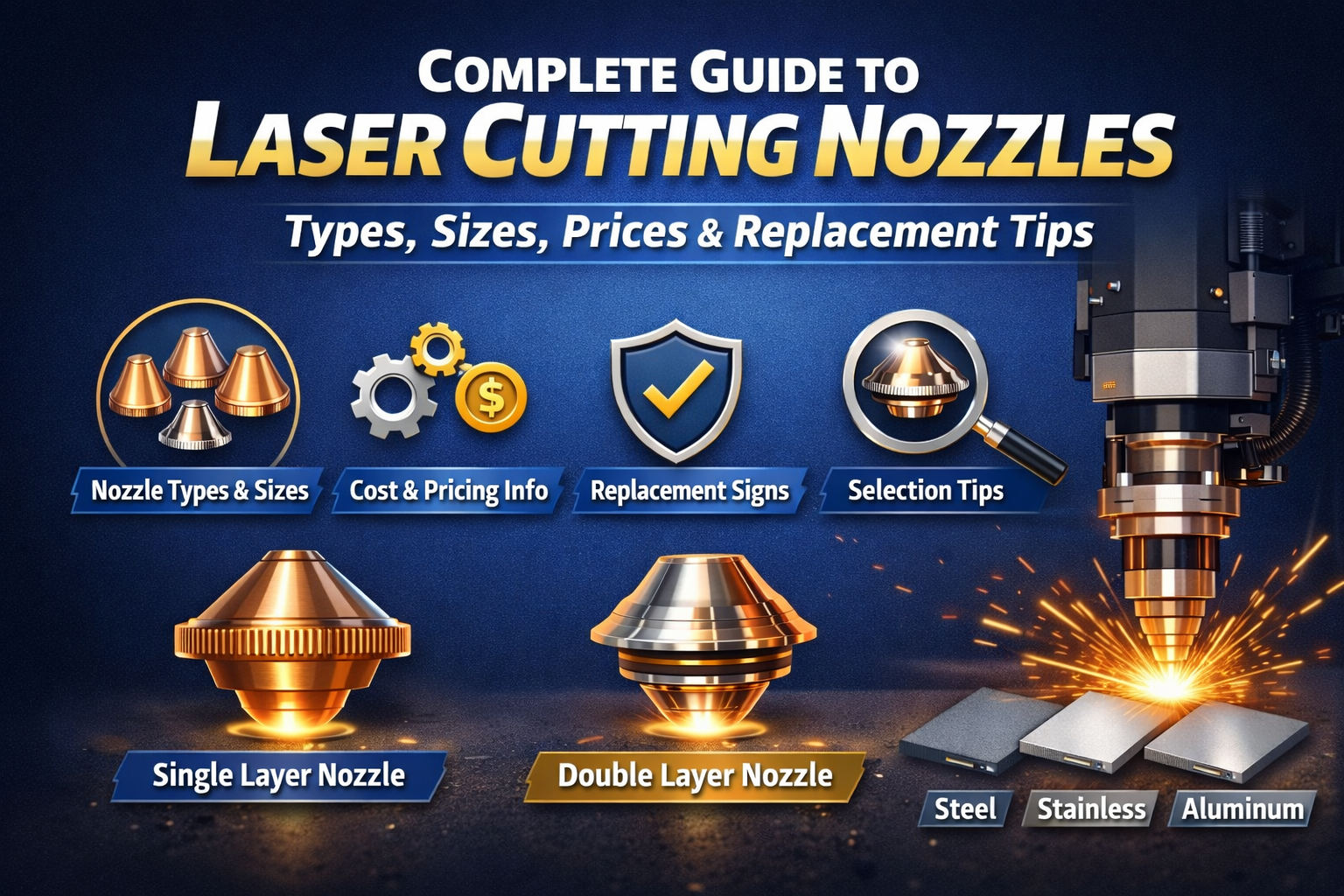
Laser cutting performance depends heavily on small components that often receive less attention. Among them, the nozzle plays a direct role in gas flow stability, cutting precision, and overall machine productivity.
This guide explains everything about laser cutting nozzles including types, sizes, materials, pricing factors, maintenance practices, and replacement guidelines so operators, buyers, and dealers can make confident decisions.
Key takeaways
- Laser nozzles control assist gas direction and cutting efficiency
- Different nozzle designs suit different materials and cutting speeds
- Proper sizing and maintenance reduce dross, burr, and rework
- Replacement timing directly affects cut quality and machine safety
What is a Laser Cutting Nozzle?
A laser cutting nozzle is a precision metal component mounted at the laser head tip. It directs assist gas concentrically around the laser beam to remove molten material and protect the optics.
Without a correctly functioning nozzle, the laser beam cannot achieve stable kerf formation, resulting in poor edge quality, spatter, and inconsistent cutting.
Key points
- Positioned at the lowest part of the cutting head
- Shapes gas pressure distribution around the beam
- Protects focusing lens from back spatter
- Impacts cut smoothness and speed
Why Laser Cutting Nozzles are Critical for Cutting Quality
The nozzle influences gas velocity, pressure concentration, and beam alignment, which together determine the final cutting result. Even a slight deformation can change gas flow symmetry and degrade performance.
A well-selected nozzle improves cutting speed, reduces oxidation, and maintains consistent kerf width across long production runs.
Key points
- Controls gas shielding effectiveness
- Maintains uniform kerf width
- Prevents molten metal adhesion
- Supports stable piercing performance
How Laser Cutting Nozzles Work
Laser nozzles operate by channeling assist gas through a precisely machined orifice around the laser beam. This gas removes molten material, cools the cutting zone, and prevents oxidation depending on gas type.
The concentric design ensures the laser beam remains centered while gas flows evenly across the cutting surface.
Key points
- Assist gas flows through nozzle orifice
- Gas pressure ejects molten metal
- Maintains thermal stability near cut zone
- Supports reactive and non-reactive cutting
Types of Laser Cutting Nozzles
Laser cutting nozzles are categorized by design structure, layer configuration, and application. Selecting the correct type ensures optimal cutting performance and reduced consumable cost.
Single Layer Nozzle
Single layer nozzles feature one gas channel and are typically used for oxygen cutting applications such as mild steel. They support reactive cutting where oxidation assists material removal.
Their simple design allows stable flame-assisted cutting with strong penetration capability.
Key points
- Single gas channel design
- Common for oxygen cutting
- Suitable for mild steel processing
- Lower cost compared to dual layer
Double Layer Nozzle
Double layer nozzles include inner and outer gas channels to provide better gas shielding and smoother cutting. They are commonly used with nitrogen for stainless steel and aluminum.
This design improves laminar gas flow and reduces oxidation, producing bright, burr-free edges.
Key points
- Dual gas channel configuration
- Ideal for nitrogen cutting
- Enhances surface finish quality
- Supports high-speed cutting
Single vs Double Layer Nozzle
Choosing between single vs double layer nozzle depends on material type, assist gas, and required finish quality. Each configuration delivers unique benefits for different cutting scenarios.
Single layer nozzles excel in oxygen-assisted cutting while double layer nozzles provide better gas shielding for inert gas cutting processes.
Key points
- Single layer for reactive oxygen cutting
- Double layer for inert nitrogen cutting
- Dual layer improves surface brightness
- Selection depends on material and finish
Laser Cutting Nozzle Sizes Explained
Nozzle size refers to the diameter of the orifice through which assist gas flows. Size selection affects gas velocity, pressure distribution, and kerf width.
Smaller nozzles provide concentrated gas flow for thin materials while larger diameters support thick plate cutting.
Common Nozzle Diameter Range
Industrial laser nozzles typically range from 0.8 mm to 4.0 mm depending on machine power and application requirements.
Operators must match nozzle diameter with material thickness and assist gas type.
Key points
- 0.8 to 1.2 mm for thin sheets
- 1.4 to 2.0 mm for medium thickness
- 2.5 to 4.0 mm for thick plates
- Diameter affects gas pressure concentration
Impact of Nozzle Size on Cutting Performance
Incorrect nozzle sizing leads to turbulence, unstable cutting, and edge defects. Proper sizing ensures optimal gas velocity and heat removal.
Key points
- Smaller size increases gas speed
- Larger size improves molten removal
- Affects piercing stability
- Impacts edge smoothness
Materials Used in Laser Cutting Nozzles
Nozzle material determines durability, conductivity, and resistance to heat and spatter. Manufacturers select metals that balance performance and cost.
Copper Nozzles
Copper offers excellent thermal conductivity and electrical properties, making it a popular nozzle material. It helps dissipate heat and supports stable capacitive height sensing.
Key points
- High conductivity
- Good heat dissipation
- Widely used standard option
- Moderate wear resistance
Chrome Plated Nozzles
Chrome plating enhances surface hardness and reduces spatter adhesion. These nozzles last longer in demanding production environments.
Key points
- Improved wear resistance
- Reduced spatter sticking
- Longer service life
- Slightly higher cost
Laser Cutting Nozzle Shapes and Designs
Apart from size and layer structure, nozzle geometry also affects gas flow characteristics and cutting behavior.
Conical Nozzle Design
Conical designs help accelerate gas flow toward the cutting zone and support deeper penetration during thick plate cutting.
Key points
- Focused gas direction
- Supports deep cuts
- Common in heavy plate processing
Straight Nozzle Design
Straight nozzles produce stable gas flow suitable for general cutting tasks and thin material applications.
Key points
- Stable gas distribution
- Suitable for thin sheets
- Easier maintenance
Laser Cutting Nozzle Price Guide
Laser nozzle pricing varies depending on brand, material, coating, and manufacturing precision. Understanding cost drivers helps buyers manage consumable budgets effectively.
Entry-level nozzles are affordable while premium precision nozzles cost more due to tighter tolerances and durability.
Factors Affecting Nozzle Price
Several variables influence nozzle cost including material, plating, manufacturing accuracy, and compatibility with specific cutting heads.
Key points
- Material quality
- Surface coating
- Precision machining
- Brand compatibility
Average Market Price Range
Typical industrial nozzle prices range from budget consumables to high-precision OEM components depending on application requirements.
Key points
- Standard nozzles low cost
- Premium plated nozzles higher cost
- OEM nozzles most expensive
- Bulk purchase reduces cost
How to Choose the Right Laser Cutting Nozzle
Selecting the right nozzle involves evaluating material type, machine power, assist gas, and desired cut finish. A systematic approach ensures consistent production quality.
Operators should also consider compatibility with cutting head models to avoid fitting and sensing issues.
Key points
- Match nozzle with material
- Consider assist gas type
- Check head compatibility
- Evaluate production speed needs
Signs Your Laser Cutting Nozzle Needs Replacement
Laser nozzles wear over time due to heat exposure, spatter adhesion, and accidental collisions. Identifying replacement signs prevents quality loss and downtime.
Regular inspection helps detect damage before it affects production.
Key points
- Visible deformation
- Spatter accumulation
- Uneven cutting edges
- Height sensing instability
Laser Cutting Nozzle Replacement Process
Replacing a nozzle is a routine maintenance task that ensures stable cutting performance. Following proper steps protects sensitive cutting head components.
Operators should clean mounting surfaces and verify alignment during replacement.
Key points
- Power off machine
- Remove damaged nozzle
- Clean seating area
- Install new nozzle securely
Maintenance Tips to Extend Laser Nozzle Life
Preventive maintenance increases nozzle lifespan and maintains cutting consistency. Simple daily practices reduce consumable cost and downtime.
Cleaning, inspection, and proper storage play important roles in nozzle longevity.
Key points
- Clean after production shifts
- Avoid manual scratching
- Store in protective trays
- Inspect before each job
Common Laser Cutting Nozzle Problems and Solutions
Operational issues related to nozzles often manifest as poor edge quality or unstable cutting. Understanding root causes enables quick corrective action.
Troubleshooting typically involves checking alignment, damage, or gas pressure mismatch.
Key points
- Burr formation from worn nozzle
- Spatter from incorrect size
- Uneven kerf from misalignment
- Cutting interruption from blockage
Laser Cutting Nozzle Compatibility with Cutting Heads
Different cutting heads require specific nozzle threading and geometry. Using incompatible nozzles may cause sensing errors or mechanical damage.
Buyers should verify compatibility before purchasing consumables.
Key points
- Thread type must match head
- Height sensing depends on nozzle
- OEM specifications matter
- Compatibility prevents damage
Laser Cutting Nozzles for Different Materials
Material characteristics influence nozzle selection due to differences in melting behavior, thermal conductivity, and oxidation response.
Mild Steel Cutting
Mild steel cutting often uses oxygen with single layer nozzles to promote reactive cutting and deep penetration.
Key points
- Single layer preferred
- Oxygen assist gas
- Suitable for thick plates
Stainless Steel Cutting
Stainless steel requires nitrogen cutting with double layer nozzles to achieve oxidation-free bright edges.
Key points
- Double layer nozzle
- Nitrogen gas
- Smooth bright finish
Aluminum Cutting
Aluminum cutting demands stable inert gas flow and proper nozzle sizing to prevent spatter and edge roughness.
Key points
- Double layer configuration
- Nitrogen assist gas
- Smaller diameter preferred
Impact of Nozzle Alignment on Cutting Quality
Nozzle alignment directly affects beam centering and gas symmetry. Misalignment results in uneven kerf width and unstable cutting behavior.
Routine alignment checks ensure consistent production output.
Key points
- Beam must be centered
- Gas flow symmetry critical
- Misalignment causes burr
- Regular calibration needed
Future Trends in Laser Cutting Nozzle Technology
Laser cutting consumables continue to evolve with improvements in coating technology, precision manufacturing, and smart monitoring integration.
Advanced nozzle designs aim to extend lifespan and enhance cutting stability for high-power fiber lasers.
Key points
- Advanced surface coatings
- High precision machining
- Smart monitoring integration
- High-power compatibility
Final Thoughts on Laser Cutting Nozzles
Laser cutting nozzles may appear simple but they play a major role in cutting performance, productivity, and consumable cost. Proper selection, maintenance, and timely replacement ensure stable production and high-quality output.
Understanding differences in nozzle types, sizes, materials, and applications helps operators maximize machine capability while minimizing downtime.
Key points
- Small component with major impact
- Correct type improves productivity
- Maintenance extends lifespan
- Replacement ensures quality consistency

Write a comment
Your email address will not be published. All fields are required