

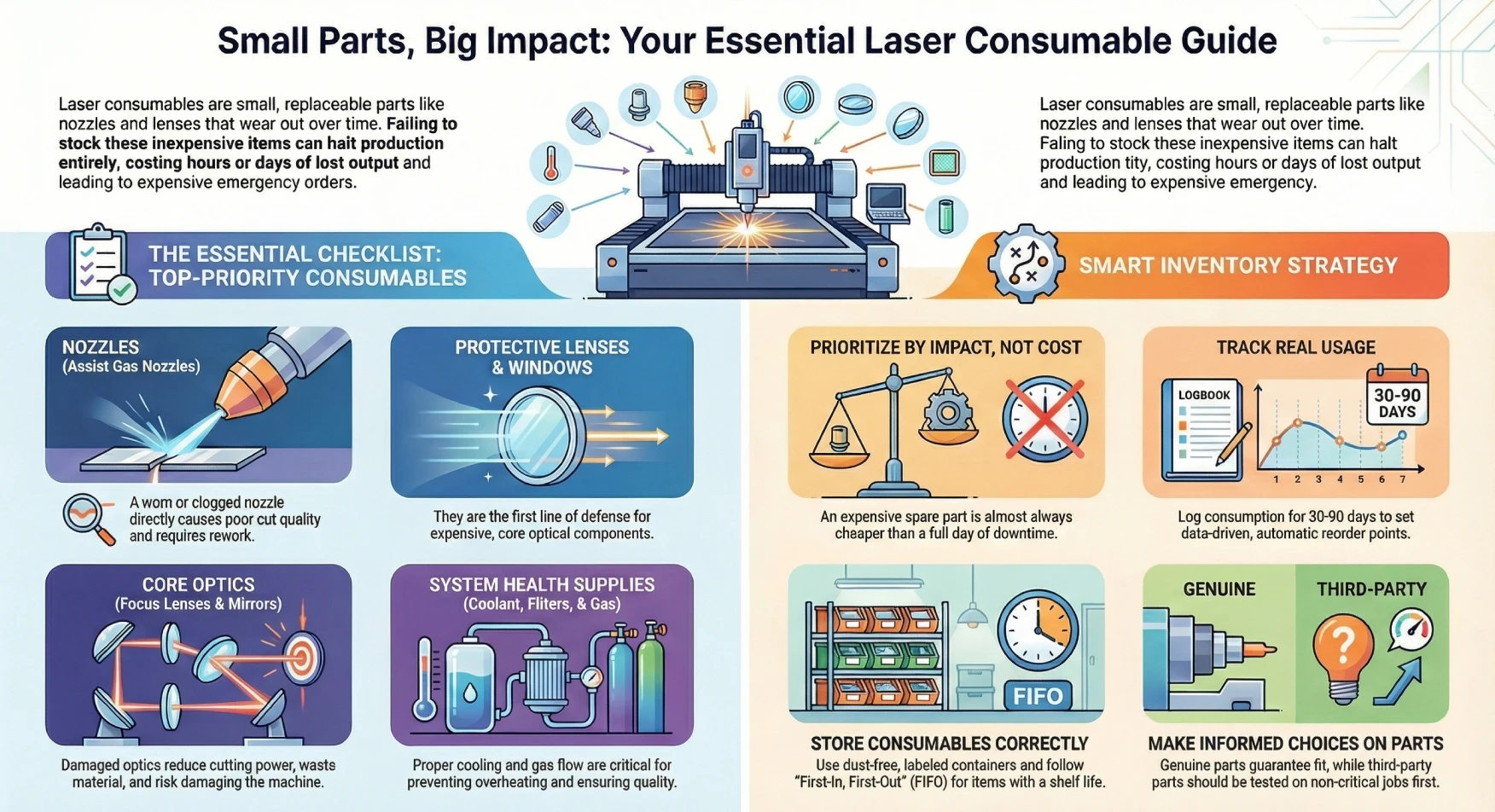
For any workshop that relies on laser cutting, marking, or welding, the machine itself is only part of the story. Consumables – the small parts and supplies that wear out or get used up – determine how often your machine stops, how fast repairs happen, and how consistent your production quality is. Running out of a single tiny item (a nozzle, a protective lens, or a regulator) can halt a production run and cost hours or even days in lost output.
This guide lists the Top 10 laser consumables you should always have in stock, explains why each matters, how to store them, and gives quick tips on reorder levels and selecting genuine parts. It’s written in plain language so technicians, shop owners, and purchasing managers can use it as a checklist.
1. Nozzles (Cutting/Assist Gas Nozzles)
- Why: The nozzle shapes and directs the assist gas (oxygen, nitrogen) to the cutting zone. A worn or clogged nozzle causes poor cut quality, increased kerf, edge dross, and more rework.
- How many to keep: For a busy shop, keep at least a 1-2 week supply per nozzle type/size you use.
- Storage & handling: Store in labelled, dust-free trays. Inspect for wear or carbon build-up before reuse.
- Tip: Keep different nozzle types (piercing vs. finish cut, different diameters) separated and labelled.
2. Protective Lenses / Windows (F-theta lenses, protective glass)
- Why: These protect optics from smoke, spatter and debris. A damaged lens reduces beam quality and can irreparably damage more expensive optics.
- How many to keep: 1-2 spares per machine for critical lenses; more if you process abrasive or dirty materials.
- Storage & handling: Keep in their protective cases, handle with lint-free gloves, and follow manufacturer cleaning procedures.
- Tip: Replace protective windows before they have visible pits or burns – small damage can quickly escalate.
3. Focus Lenses & Mirrors (for CO₂ systems) / Fiber Collimators & Focus Lenses (for fiber systems)
- Why: Core to beam delivery. Damaged or contaminated mirrors & lenses reduce cutting power and accuracy.
- How many to keep: At least one spare set of mirrors (CO₂) or one spare fiber collimator + focus lens set (fiber) per machine.
- Storage & handling: Store in dry, anti-static packaging. Avoid touching optical surfaces.
- Tip: Use genuine or OEM-equivalent optics for best alignment and lifetime.
4. Protective Caps, Ceramic Insulators & Shields (Laser Head Consumables)
- Why: These small parts protect the laser head and focus lens from molten spatter and heat. They’re cheap but critical.
- How many to keep: Small parts are consumed quickly – keep a 2-4 week supply based on throughput.
- Storage & handling: Keep sets paired with the head type (model) and inspection logs showing fitment dates.
- Tip: Carry commonly used sizes and an assortment of replacement kits for older machines.
5. Assist Gas Cylinders & Regulators (O₂, N₂, Compressed Air)
- Why: Proper pressure and purity of assist gas directly affect cut quality, speed and edge oxidation. A depleted cylinder or faulty regulator can ruin a job.
- How many to keep: Maintain at least one full cylinder of each gas type in reserve and one backup regulator per machine. For high-volume shops, consider automatic changeover systems.
- Storage & handling: Comply with gas cylinder safety (secure storage, ventilation). Store regulators in dry, dust-free location.
- Tip: Track cylinder usage by job type to forecast reorder times.
6. Water Cooling Consumables (Coolant, Filters, Hoses, Water Chillers Service Kits)
- Why: Many lasers require stable cooling. Contaminated coolant or clogged filters cause overheating, reduced power, and expensive damage.
- How many to keep: Keep one full coolant change kit and replacement filters/hose clamps per chiller. For small shops, a spare chiller filter and a 20-25L backup of recommended coolant are good.
- Storage & handling: Use manufacturer-recommended coolant. Store chemicals in labeled containers away from heat and direct sunlight.
- Tip: Schedule coolant changes and filter cleanings to avoid emergency shutdowns.
7. Fiber Pigtails, Couplers & Protective Boots (for fiber lasers)
- Why: Fiber connections can be delicate. Damaged pigtails/couplers disrupt beam delivery. Having spares avoids long delays waiting for custom parts.
- How many to keep: At least one spare pigtail and one spare coupler per laser line; more if you perform frequent head changes.
- Storage & handling: Keep fibers capped and in dust-free packaging. Use fiber cleaning tools before every connector mating.
- Tip: Train staff on fiber connector cleaning – many failures are due to contamination.
8. Safety Consumables (Laser Safety Goggles, Interlock Parts, Warning Labels)
- Why: Safety must never be compromised. Goggles and interlock parts wear out; warning signage fades.
- How many to keep: Enough goggles for all operators and visitors; a spare set for each shift. Keep replacement interlock switches and labels on hand.
- Storage & handling: Store goggles in clean, labelled cases. Regularly test door interlocks and replace defective components immediately.
- Tip: Keep a visible safety kit with spare goggles and basic PPE near the laser room.
9. Electrical Consumables (Fuses, Connectors, Relays, Cable Ties)
- Why: Electrical faults are common root causes of machine downtime. Simple parts like fuses or relays can be swapped quickly to restore operation.
- How many to keep: A small box with assorted fuses, an extra relay or two, and spare connectors for your machine model.
- Storage & handling: Label parts with machine model and circuit location. Follow lockout-tagout (LOTO) when replacing electrical parts.
- Tip: Log any electrical replacements – patterns can reveal underlying issues.
10. Cleaning Supplies & Maintenance Kits (Lens wipes, IPA, nozzle brushes, compressed air)
- Why: Good housekeeping extends consumable life. The right cleaning supplies prevent buildup that damages optics and nozzles.
- How many to keep: Keep an inventory of lens wipes, isopropyl alcohol, nozzle brushes, soft cloths, and desiccant packs that lasts at least 1-2 months.
- Storage & handling: Use lint-free wipes for optics; store alcohol in secure containers. Avoid canned air near optics (use filtered dry compressed air).
- Tip: Create a daily/weekly maintenance checklist and keep the consumables kit next to the machine for quick access.
How to Prioritize What to Stock (Quick Rules)
- Criticality first: Optics and nozzles that directly affect cut quality deserve the highest priority.
- Lead time next: If an item takes weeks to arrive (specialized optics, custom pigtails), increase your safety stock.
- Cost vs. downtime: Even expensive spares are cheaper than a day of lost production.
- Usage-based reorder: Track actual consumption for 30-90 days then set reorder points (e.g., reorder when stock falls to two days’ usage).
- Common vs. niche: Keep generous stock of commonly used sizes/types and minimal stock of rarely used specialty parts.
Genuine Parts vs. Third-Party Consumables – What to Consider
- Quality & Fit: Genuine or OEM-equivalent parts usually guarantee fit and optical alignment. Third-party parts can be cheaper but may require recalibration or cause premature wear.
- Warranties & Support: Using non-genuine parts can void manufacturer warranties. Check warranty terms before switching.
- Price Sensitivity: For non-critical items (cable ties, some electrical connectors), reputable third-party brands are fine. For optics and heads, favor genuine parts.
- Testing: If you try a third-party consumable, test it on non-critical jobs first to confirm performance.
Simple Inventory Template (Example)
- Nozzles: Keep 20 units (various diameters) – reorder when 8 left.
- Protective lenses/windows: Keep 3 – reorder when 2 left.
- Focus lenses & mirrors: Keep 2 sets – reorder when 1 set left.
- Consumable head caps & shields: Keep 50 pieces – reorder when 20 left.
- Gas cylinders: Keep 1 full spare per gas type + one backup regulator.
- Coolant & filters: Keep 1 coolant change kit + 2 spare filters.
- Fiber pigtails & couplers: Keep 1 spare each (plus specialty spares if long lead times).
- Safety goggles: Keep enough for all operators + 2 spare pairs.
- Electrical fuses/connectors: Assorted box – reorder when stock dips below predefined counts.
- Cleaning kit: Keep enough supplies for 30 days of cleaning.
Use a simple spreadsheet to log consumption and dates; it pays back in reduced emergency orders.
Maintenance & Storage Best Practices
- FIFO (First-In, First-Out): Use older stock first for consumables with shelf life (coolant, adhesives).
- Clean storage: Store optics and lenses in dust-free trays; keep chemicals sealed.
- Label everything: Include part number, compatible machine models, and purchase date.
- Environmental control: Humidity and temperature can affect optics and electronics – store in moderate, dry conditions.
- Training: Teach operators to inspect consumables daily and to report small issues before they escalate.
Common Mistakes to Avoid
- Understocking cheap items: Small parts are cheap but their absence is costly.
- Overreliance on single supplier: Keep alternative suppliers or keep larger safety stock for single-source items.
- Skipping genuine parts entirely: False economy – poor-quality optics or nozzles can increase scrap and machine wear.
- No inventory tracking: Without simple tracking you’ll always be reacting.
Conclusion – Small Parts, Big Impact
Consumables are the unsung heroes of smooth laser operations. With a thoughtful stocking strategy – focusing on critical items like nozzle sets, protective optics, and cooling consumables – you can dramatically reduce downtime, improve cut quality, and protect your investment. Start with the ten items above, set simple reorder points, and refine your inventory based on real usage. You’ll save money and stress in the long run.
Write a comment
Your email address will not be published. All fields are required